The Platform
Seasonal eating
Wednesday 31st October 2018
Find out the facts (and bust some myths) about choosing seasonal and local food
Eating Seasonally
During World Green Building Week we asked you to pledge how you would be reducing your carbon footprint. A great number of people said they would like to eat more seasonally or choose locally sourced produce. Without a fruit and veg patch, it can be really difficult to see what is in season because the supermarket stocks certain items all year round. This series will help to let you know what you should be eating when.
Before you learn what produce is in season, get the facts about the impacts of choosing local food and eating seasonally.
Be in the know
In 2015, 52% of the food we ate was supplied by UK farmers. This falls to just 23% when considering fruit and vegetables. Meanwhile, many of the countries important for providing us with food (Spain, South Africa, Egypt and India) are water-stressed, and likely to become more so in the future (University of York, 2017). Other environmental benefits include reduced air pollution from food in transit.
Meanwhile, there are a number of benefits to eating seasonally. Food simply tastes better when it is in season; a pale tomato is January is never going to be a flavour explosion. Also, the price of in-season produce tends to be lower than something that isn’t.
Eating seasonally is linked to eating locally: it easier to eat locally if you are choosing in-season produce. However, choosing local doesn’t solve all problems!
Myth busting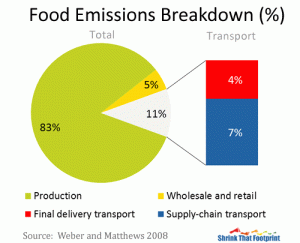
‘Food miles’, the calculation of how far food travels between production and consumer, has become a proxy for measuring the sustainability of food. The common belief is the further the more carbon produced. Thus, choosing local is better…
However, the environmental saving from eating locally is not guaranteed. Food Miles only make up 11% of the emissions associated with food consumption (Webber and Matthews, 2008). Therefore, if you are buying local, out-of-season food there may not be any benefit (or even worse impacts!) due to:
- Electricity used to store food
- Intensive energy requirements to grow food in a non-native climate
- Fertislier (which produced CO2) used to grow food from warmer areas in colder climate
This makes it even more important to choose seasonal produce.
Honest Food for Thought
To be perfectly honest, the benefits of eating seasonally pale in comparison to some other changes you can make with your diet. Webber and Matthews (2008) suggest dietary shifts to less carbon-intensive foods may have the greatest impact on your carbon footprint. For example, red meat is around 150% more carbon intensive than chicken or fish. They argue that shifting one day a week from red meat and dairy products to chicken, fish, eggs, or a vegetarian meal (Meat-Free Monday!) achieves more GHG reduction than buying all locally sourced food. Nevertheless, combatting climate change requires small actions which will add up to big change. Therefore, it is still important to make carbon-saving actions, no matter how small they are.
Blog Archive
-
 Most recent posts
- October 2019
- September 2019
- August 2019
- July 2019
- June 2019
- May 2019
- April 2019
- March 2019
- February 2019
- January 2019
- December 2018
- November 2018
- October 2018
- June 2018
- May 2017
- February 2017
- December 2016
- November 2016
- August 2016
- July 2016
- April 2016
- October 2015
- September 2015
- June 2015
- May 2015
- April 2015
- March 2015
Follow us


Please enter your login details below...
Not registered? Sign up here